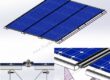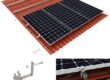
For commercial and industrial flat roof solar installations, the fundamental tension has always been between energy yield and roof integrity. Fixed tilt systems are simple and low-cost, but they leave significant generation potential untapped by not optimizing the angle toward the sun. Ballasted systems avoid roof penetrations, protecting the waterproofing membrane, but often sacrifice tilt angle for stability. The Flat Roof Mounting-Adjustable Ballast Series (SUS304 / AL6005-T5) for Commercial Solar Projects — Tilt Adjustable 0°–60°, Wind Load 60 m/s, Snow Load 3.6 kN/m² resolves this tension. By combining a ballasted foundation with a fully adjustable tilt mechanism, it allows installers to optimize the panel angle for seasonal or latitude-specific irradiance without a single roof penetration. But how does the adjustable ballast system achieve both high wind resistance and variable tilt, and what specific engineering choices make it suitable for buildings up to 20 meters in height?
The Core Innovation: Ballasted Stability Plus Variable Tilt
Traditional flat roof ballasted systems use concrete blocks or precast ballast trays to hold the array in place against wind uplift. The trade-off is that the panels are typically mounted at a fixed, low tilt angle (5°–15°) to maintain a low center of gravity and reduce wind loading. This fixed angle is a compromise—it captures less energy than a steeper tilt optimized for the site’s latitude.
The Adjustable Ballast Series solves this by separating the ballast function from the tilt function:
-
Ballast Base: Concrete blocks or ballast trays are placed on the roof surface, providing gravitational resistance against wind uplift. No roof penetrations are required, preserving the waterproofing membrane and roof warranty.
-
Adjustable Tilt Mechanism: The panel support structure is hinged at the base and supported by adjustable struts that can be set at any angle from 0° to 60°. This allows the installer to dial in the optimal tilt angle for the specific installation latitude and season.
-
Load Distribution: The system is engineered to distribute wind and snow loads evenly across the ballast base and the roof structure, preventing concentrated point loads that could damage the roof deck.
Material Selection: SUS304 Stainless Steel and AL6005-T5 Aluminum
The choice of materials is critical for long-term outdoor performance in rooftop environments:
|
Component
|
Material
|
Rationale
|
|---|---|---|
|
Fasteners and Hardware
|
SUS304 Stainless Steel
|
Corrosion resistance in humid rooftop environments; prevents galvanic corrosion when in contact with aluminum
|
|
Structural Rails and Supports
|
AL6005-T5 Aluminum Alloy
|
High strength-to-weight ratio; excellent corrosion resistance; extrudable into complex profiles for integrated sliding channels and cable management
|
This material combination ensures the system can withstand the specified wind load of 60 m/s (216 km/h / 134 mph) and snow load of 3.6 kN/m² (approximately 75 psf) without structural failure or excessive deflection.
Key Design Features for Installation Efficiency
1. Pre-Assembled Components
All components are pre-assembled and pre-adjusted at the factory. This means installers on the roof spend their time positioning and securing the system rather than assembling brackets and tightening dozens of small fasteners. The result is faster installation and lower labor costs.
2. Tool-Free Angle Adjustment
The tilt mechanism is designed for tool-free or minimal-tool angle adjustment. Installers can set the angle using a simple pin-and-hole system or a hand-tightened knob, without requiring wrenches or power tools on the roof.
3. Compatibility with Framed and Frameless Modules
The system accepts both framed and frameless (laminate) solar modules in portrait or landscape orientation. This flexibility allows installers to use the most cost-effective module available at the time of installation, rather than being locked into a specific module type.
4. Modular Design for Irregular Roof Layouts
The system is modular, allowing it to be configured for rectangular, L-shaped, or irregular roof layouts. Individual rows can be offset or staggered to accommodate roof obstructions such as HVAC units, skylights, or roof drains.
Performance Benefits of Adjustable Tilt
The adjustable tilt feature is not a gimmick—it delivers measurable energy yield improvements:
-
Latitude Optimization: For a typical commercial flat roof installation at 40° latitude, increasing the tilt from 10° (typical fixed ballast) to 35° (latitude-optimized) can increase annual energy production by 15–25%, depending on local climate conditions.
-
Seasonal Adjustment: For installations where seasonal adjustment is feasible (accessible roof, maintenance crew available), the tilt can be changed twice per year—steeper in winter to capture low-angle sun, shallower in summer to reduce wind loading and overheating.
-
Snow Shedding: A steeper tilt angle encourages snow to slide off the panels naturally, reducing snow-related generation losses in northern climates.
Wind Tunnel Testing and Structural Validation
The system has been validated through wind tunnel testing or computational fluid dynamics (CFD) analysis to confirm its performance at the specified 60 m/s wind load. Key findings typically include:
-
Uplift Resistance: The ballast weight is calculated to provide sufficient resistance against uplift forces at the corner and edge zones of the roof, where wind forces are highest.
-
Dynamic Response: The system’s natural frequency is designed to avoid resonance with typical wind gust frequencies, preventing oscillation that could loosen connections over time.
-
Deflection Limits: Maximum deflection under design wind load is limited to prevent panel-to-panel contact or excessive stress on module frames.
Sourcing and Project Support for B2B Buyers
For solar EPC contractors, distributors, and project developers, the Adjustable Ballast Series offers:
-
Engineering Support: Load calculations, ballast weight schedules, and structural stamped drawings can be provided for permit submission.
-
Custom Configurations: Row spacing, tilt angle range, and ballast type (precast concrete blocks vs. pour-in-place ballast trays) can be customized for specific project requirements.
-
Sample Kits: Pre-production samples are available for installer training and quality verification before full-scale deployment.
-
Global Shipping: Components are packaged in compact, stackable cartons for efficient container loading and international shipping.
Conclusion: No Penetration, No Compromise on Yield
The Flat Roof Mounting-Adjustable Ballast Series (SUS304 / AL6005-T5) for Commercial Solar Projects proves that ballasted mounting does not have to mean compromised tilt angle. By combining a non-penetrating ballast foundation with a robust, adjustable tilt mechanism, it delivers the best of both worlds: preserved roof integrity and optimized energy harvest. For commercial building owners, EPC contractors, and solar developers seeking a versatile, high-performance mounting solution for flat roof installations, the Adjustable Ballast Series represents a proven, bankable choice.