Can a ZAM-Coated U-Steel Ballast Mounting System Really Reduce Ballast Weight While Withstanding 60 m/s Winds on Flat Roofs?
2026-06-23
For commercial flat roof solar installations, the ballast weight required to resist wind uplift has always been a double-edged sword. Enough ballast ensures stability, but too much adds dead load that may exceed the roof’s structural capacity, especially on older buildings or retrofits with limited load reserves. The Flat Roof Mounting-ZAM Steel Mounting Series (U-Steel Ballast System) for Non-Penetrating Flat Roof Solar — Tilt Adjustable 0°–60°, Wind Load 60 m/s, Snow Load 3.6 kN/m² is engineered to solve this tension. By using high-strength ZAM-coated U-steel profiles and a matrix structural design, it achieves greater stiffness and load distribution than conventional aluminum or lighter steel sections—allowing the system to use less ballast weight while maintaining the same wind resistance. But how does the U-steel profile and ZAM coating contribute to both structural performance and corrosion protection, and why does the matrix design reduce ballast requirements without compromising safety?
The U-Steel Advantage: Higher Stiffness with Less Material
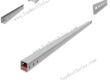
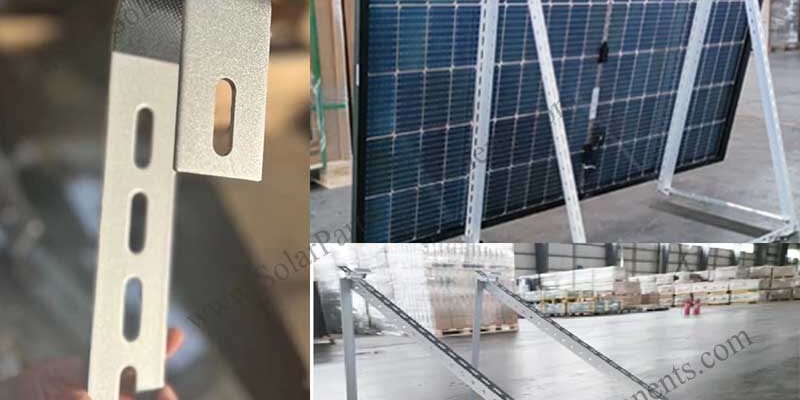
Traditional ballasted flat roof systems commonly use aluminum extrusions (AL6005-T5) for the main structural rails. While aluminum offers excellent corrosion resistance, its lower modulus of elasticity (approximately 70 GPa vs. 200 GPa for steel) means that thicker or more closely spaced sections are needed to achieve the same stiffness. The ZAM Steel Mounting Series takes a different approach by using high-strength U-shaped steel profiles (S350-ZM grade) :
-
Greater Bending Stiffness: The U-channel geometry provides a high section modulus relative to its weight, allowing longer spans between support points without excessive deflection.
-
Reduced Material Volume: Because steel is stiffer than aluminum, less material is needed to achieve the same structural performance. This partially offsets the higher density of steel (7.85 g/cm³ vs. 2.70 g/cm³ for aluminum) in terms of total system weight.
-
Improved Load Distribution: The U-steel rails transfer loads more efficiently to the ballast supports, reducing localized stress concentrations that could cause the ballast blocks to shift or crack.
ZAM Coating: Corrosion Protection Beyond Standard Galvanizing
ZAM (Zinc-Aluminum-Magnesium) alloy coating is a next-generation corrosion protection technology that significantly outperforms traditional hot-dip galvanizing:
|
Property
|
Standard HDG (Hot-Dip Galvanized)
|
ZAM Coating
|
|---|---|---|
|
Coating Composition
|
100% Zinc
|
Zn + Al + Mg alloy
|
|
Corrosion Resistance
|
Baseline
|
5–10x higher in salt spray testing
|
|
Cut-Edge Protection
|
Moderate
|
Self-healing properties at cut edges
|
|
Surface Hardness
|
Standard
|
Higher scratch resistance
|
|
Aesthetic Appearance
|
Spangled finish
|
Uniform matte gray
|
For rooftop solar installations, where the mounting structure is exposed to rain, condensation, and potentially coastal salt spray, ZAM coating provides an additional margin of safety against corrosion that could compromise structural integrity over the 25+ year design life.
Matrix Design: How Structural Geometry Reduces Ballast Requirements
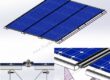
The “matrix design” mentioned in the product description refers to the interconnection of multiple U-steel rails into a grid-like structural system. This approach offers several advantages over independent row-by-row mounting:
-
Load Sharing: When wind uplift forces act on one row of panels, the matrix distributes the load to adjacent rows through the interconnected steel grid. This reduces the peak uplift force that any single ballast block must resist.
-
Reduced Ballast Weight: Because the load is shared across the matrix, the total ballast weight required is typically 15–30% less than what would be needed for independent rows with the same panel area.
-
Enhanced Torsional Stability: The grid structure resists twisting and racking under asymmetric wind loads, maintaining panel alignment and preventing progressive failure.
-
Simplified Installation: The matrix can be assembled from standard-length U-steel sections with bolted or clamped connections, requiring no welding or specialized tools on the roof.
Material Compatibility and Fastener Selection
The system uses three materials in a carefully managed combination:
|
Component
|
Material
|
Role
|
|---|---|---|
|
Main Structural Rails
|
S350-ZM U-Steel
|
Primary load-bearing members
|
|
Fasteners and Hardware
|
SUS304 Stainless Steel
|
Corrosion-resistant connections; prevents galvanic corrosion
|
|
Panel Clamps and End Caps
|
AL6005-T5 Aluminum
|
Module retention; lightweight and corrosion-resistant
|
The use of stainless steel fasteners is critical when joining steel and aluminum components, as it prevents the galvanic corrosion that would occur if unprotected steel were in direct contact with aluminum in a moist environment.
Tilt Angle Flexibility and Module Compatibility
Like the adjustable ballast series, the ZAM Steel Mounting Series offers tilt adjustment from 0° to 60°, allowing optimization for latitude and seasonal irradiance. The system accepts:
-
Framed Modules: Standard aluminum-framed crystalline silicon panels.
-
Frameless (Laminate) Modules: Glass-glass or backsheet laminates with appropriate clamping adapters.
-
Portrait or Landscape Orientation: The matrix can be configured for either orientation, providing flexibility for module selection and roof layout optimization.
Applications and Building Height Limitations
The system is rated for buildings up to 20 meters in height, which covers the vast majority of commercial and industrial flat roof installations. For taller buildings, additional wind tunnel testing or CFD analysis may be required to confirm the ballast weight calculation, as wind speeds increase with height above ground level.
Typical applications include:
-
Warehouse and distribution center roofs
-
Retail big-box store roofs
-
Manufacturing facility roofs
-
Office building flat roofs
-
Apartment and condominium flat roofs
Sourcing and Project Support
For solar EPC contractors and project developers, the ZAM Steel Mounting Series offers:
-
Engineering Calculations: Ballast weight schedules and structural calculations provided for permit submission.
-
Custom Configurations: Row spacing, tilt angle, and ballast type can be customized.
-
Compact Packaging: The U-steel profiles nest efficiently for shipping, reducing freight costs.
-
Global Availability: Export packaging and container loading plans provided for international projects.
Conclusion: Less Ballast, Same Safety, Higher Efficiency
The Flat Roof Mounting-ZAM Steel Mounting Series (U-Steel Ballast System) for Non-Penetrating Flat Roof Solar demonstrates that reducing ballast weight does not have to mean compromising wind resistance. By combining high-strength ZAM-coated U-steel profiles with a load-sharing matrix design, it achieves the structural performance needed for 60 m/s wind loads while using less ballast than conventional systems. For project developers and EPC contractors working on flat roof installations with limited load capacity, this system offers a practical, code-compliant path to maximizing solar generation without exceeding the roof’s structural limits.