

A pergola already does one job well: it creates usable outdoor space. Add solar panels to the roof, and it does two — shade and electricity from the same structure and the same footprint.
Solar pergolas are gaining traction across residential gardens, commercial patios, poolside areas, EV charging bays, and hospitality venues. They work especially well when roof-mounted solar isn’t practical — whether because of roof orientation, shading, structural limitations, or simply because the client wants the panels somewhere more visible and functional.
This guide covers how solar pergolas work, what makes a mounting system perform well on them, the key structural and design considerations, and answers to the questions installers and project developers ask most often.
What Is a Solar Panel Pergola?
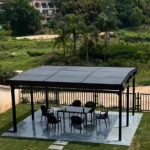
A solar pergola is an outdoor structure — typically aluminum or steel framed — where photovoltaic panels replace or supplement the roof surface. Instead of timber slats, polycarbonate sheeting, or open sky, the roof consists of solar panels mounted on rails, generating electricity while providing shade below.
The panels can be laid flat, tilted at a fixed angle, or in some premium configurations, mounted on adjustable tilt systems that track seasonal sun angles. The structure sits on ground footings (concrete or helical ground screws) and is entirely freestanding — independent of any building roof.
Electrically, the system connects to an inverter in the same way as any other PV installation. It can be grid-tied, off-grid with battery storage, or hybrid.
Why Choose a Pergola Over Roof-Mounted Solar?
Solar pergolas aren’t a compromise — for certain situations, they are the better choice:
When the roof isn’t suitable Older roofs nearing end of service life, roofs with poor orientation, heavily shaded roofs, or flat roofs already occupied by HVAC equipment are all good candidates for a pergola alternative.
When the client wants dual-use space A well-designed solar pergola creates covered outdoor space that would otherwise require a separate structure. The shade structure and the solar system share the same cost base — posts, foundations, and framing serve both purposes.
When aesthetics matter Commercial venues, hotels, resorts, and upscale residential projects often prefer solar pergolas because they are visible, architectural, and designed. A solar pergola is a feature; a rooftop array is largely invisible.
When ground-level access is needed Pergola panels are installed at working height, simplifying maintenance, cleaning, and eventual panel replacement without the safety complications of roof access.
When additional capacity is needed For properties that already have rooftop solar and want to expand capacity, a pergola is often the most practical route to additional generation without modifying the roof.

This is where most design errors happen. A solar pergola looks simple — panels on a frame — but the structural demands are real and need to be taken seriously.
Panel weight
Panel weight varies significantly by manufacturer, wattage, and glass configuration — bifacial glass-glass panels are heavier than standard glass-backsheet modules of the same wattage. Multiply panel weight across the full array, then add mounting rails, clamps, wiring, and hardware, and the total roof load is substantial. Always use the actual datasheet weight of the specified panel when calculating structural loads, and include a margin for hardware and wiring.
Wind uplift
Wind is almost always the governing load on a solar pergola, not panel weight. Panels act as sails. Edge and corner zones experience the highest uplift forces, and clamp pull-out loads at these positions can be significantly higher than at mid-array. Rail span, clamp spacing, and anchor design must all be calculated to local wind codes with appropriate safety factors as required by the applicable structural standard.
Tilt angle and lateral load
Tilted panels on a pergola roof increase stress, especially under wind uplift. Even a modest tilt of 10–15° changes the wind load profile significantly compared to flat-mounted panels. If clients want tilted panels for better energy yield, the structural design must account for this from the start.
Foundation and post sizing
Freestanding structures with no lateral bracing from a building wall need correctly sized foundations. Helical ground screws offer a fast, reversible foundation option; concrete footings are more common for permanent commercial installations. Post sizing and bracing design should be verified by a structural engineer for any commercial project.
Mounting System Components for Solar Pergolas
The mounting hardware for a solar pergola follows the same logic as any ground mount or carport system — rails, clamps, and module-level fasteners — but with a few specific considerations.
Aluminum mounting rails
Aluminum extrusion rails span between the pergola’s roof beams, forming the base grid onto which panels mount. Rail span and profile size should be selected to meet the deflection and load requirements of the project — consult the rail manufacturer’s load tables for the specific profile being used. Standard rail lengths can be joined with splice connectors for longer runs.
Mid and end clamps
Panels attach to rails using mid clamps (between panels) and end clamps (at the array perimeter). For pergola applications, clamp pull-out resistance is critical — verify load ratings against the project’s wind uplift calculations. Stainless steel hardware is recommended for outdoor freestanding structures exposed to weather on all sides.
Adjustable tilt brackets
If panels are to be tilted rather than laid flat on the pergola roof frame, adjustable tilt brackets allow the angle to be set at installation. As a general principle, panels in the northern hemisphere should face south, with a tilt angle close to the site’s latitude to maximize annual energy yield. Southern hemisphere sites should face north. For the most accurate yield estimate, a site-specific solar resource assessment is recommended.
Grounding and bonding hardware
Because pergola structures are freestanding metal frames in outdoor locations, proper grounding and bonding of the entire structure — rails, frames, and panels — is essential for electrical safety and code compliance. Grounding clips, bonding jumpers, and earthing lugs should be specified as part of the mounting system, not added as an afterthought.
Cable management
With panels mounted at working height and wiring running through an open structure, cable routing needs to be neat, protected, and UV-resistant. Cable clips and conduit ties designed for solar applications keep wiring secure and prevent chafing against structural members.
Panel Selection Considerations for Pergolas
Not every panel type is equally suited to pergola applications.
Bifacial panels are a popular choice for pergolas, and not just for the marginal gain from rear-side light capture. An array of bifacial panels resembles a glass roof, and when you look up through the structure, it is considerably more visually appealing than the plastic backsheet of standard panels. For commercial and hospitality projects where aesthetics are part of the brief, bifacial glass-glass modules are often the preferred specification.
Full-black or all-black panels suit residential garden pergolas where a cleaner visual appearance is preferred over maximum wattage.
Standard monocrystalline panels offer the best watt-per-dollar ratio for projects where visual appearance is secondary and energy output is the priority.
Panel size affects pergola roof dimensions directly. Larger format panels cover more area per unit but require a correspondingly larger structural bay. Always confirm the exact dimensions of the specified panel from the manufacturer’s datasheet, and design the pergola framing around those dimensions — not the other way around.
Installation Sequence
A typical solar pergola installation follows this sequence:
- Foundation installation— Concrete footings poured or helical ground screws installed to specified depth and bearing capacity
- Post and beam erection— Main structural frame assembled and checked for plumb and level
- Rail installation— Mounting rails fixed to roof beams at correct spacing for panel dimensions
- Panel placement— Panels positioned and clamped to rails, starting from one end of the array
- Grounding and bonding— All metalwork bonded, earthing connection made to grounding point
- DC wiring— String wiring run from panels to combiner or directly to inverter
- Inverter and AC connection— Inverter mounted (typically on a post or adjacent wall), AC connection made to grid or battery system
- Inspection and commissioning— Structural check, electrical inspection, system test
Frequently Asked Questions
Does a solar pergola need planning permission? In most jurisdictions, yes — both the structure and the electrical installation typically require permits. Requirements vary significantly by location. For commercial projects, structural drawings stamped by a licensed engineer are usually required. For residential garden pergolas, requirements are more variable. Always check local regulations before proceeding.
Can I add solar panels to an existing wooden pergola? Possibly, but with caution. Wooden pergolas, especially older ones, are usually not designed with solar in mind. Even steel pergolas may need reinforcement depending on beam sizes and spacing. A structural assessment is strongly recommended before mounting panels on any existing structure not originally designed for the load.
What is the typical energy output of a solar pergola? Output depends heavily on system size, panel tilt and orientation, local sun hours, and shading — so there is no single “typical” number that applies globally. A site-specific yield estimate using local solar irradiation data is the only reliable way to predict actual output. Most solar design tools (PVSyst, SAM, or similar) can generate this estimate from the project coordinates and system specifications.
How far from the house can a solar pergola be? There is no structural limit, but electrical losses increase with cable run length. The further the solar pergola is from the house, the higher the energy losses. For longer cable runs, cable sizing should be increased to keep resistive losses below 1–2%. Inverter location also affects system design — microinverters mounted directly on the panels eliminate long DC runs, which is an advantage for pergolas some distance from the building.
Are microinverters better than string inverters for pergola installations? Often yes. Microinverters convert DC to AC at each panel, eliminating long DC cable runs and providing panel-level monitoring. They also handle partial shading better than string inverters — useful if the pergola is near trees or buildings that cast occasional shadows across part of the array. Microinverters add some weight to the system and can be concealed within the racking structure.
Does a solar pergola qualify for tax incentives? This varies by country, region, and the applicable tax year — and policies change. In some markets, a solar pergola may qualify for solar investment incentives because the structure functions as the racking system for the PV array. In others, only the panels and electrical components are eligible. Tax treatment should always be confirmed with a local tax advisor before making financial decisions based on incentive assumptions.
What frame material is best — aluminum or steel? Aluminum is the standard choice for most residential and light commercial pergolas. It is lightweight, corrosion-resistant, and requires no painting or surface treatment. Galvanized or powder-coated steel offers higher strength for larger spans and is preferred for heavy commercial or industrial applications where structural loads are more demanding. For coastal environments, marine-grade aluminum or hot-dip galvanized steel are recommended over standard steel.
Summary: Key Specification Checklist
Before ordering a solar pergola mounting system, confirm the following:
- Panel dimensions and weight (determines rail spacing and clamp selection)
- Tilt angle required (flat lay vs. fixed tilt vs. adjustable)
- Local wind speed and snow load (determines structural design loads)
- Foundation type (helical screw vs. concrete footing)
- Frame material (aluminum vs. galvanized steel)
- Grounding and bonding requirements for local electrical code
- Inverter type and location (string vs. microinverter, cable run length)
- Panel type (bifacial glass-glass vs. standard monocrystalline)
Final Thoughts
A solar pergola is one of the few solar applications where the structure itself adds value independently of the energy system. Done well, it creates useful outdoor space, generates clean electricity, and looks intentional rather than incidental.
The mounting system — rails, clamps, tilt brackets, grounding hardware — is where quality and compatibility matter most. Components rated for the actual wind and structural loads at the site, specified to fit the panel dimensions being used, and installed with correct torque and bonding will perform for the 25+ year life of the panels.
If you’re sourcing mounting hardware for a solar pergola project and need factory-direct pricing on rails, clamps, ground screws, or complete carport and pergola racking systems, contact our team for project-specific specifications and lead times.