


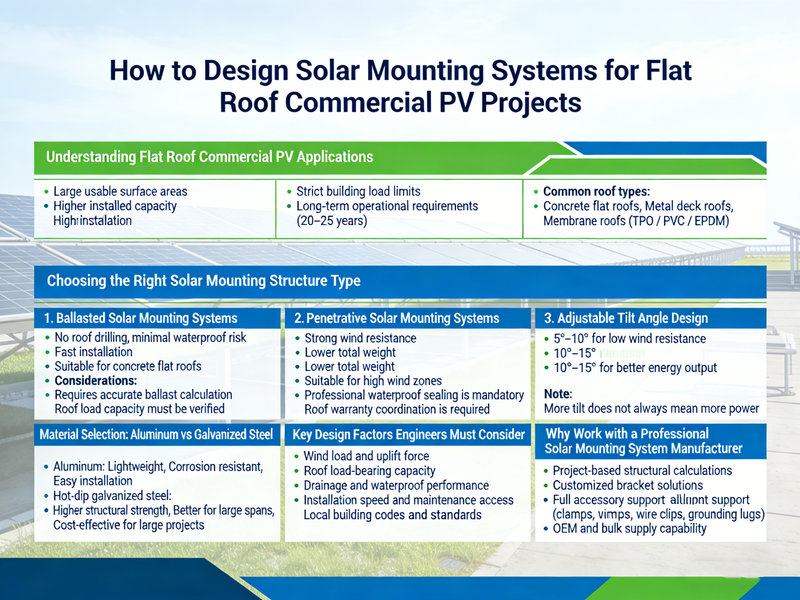
Flat roof commercial photovoltaic (PV) projects are growing rapidly worldwide, especially in factories, warehouses, shopping malls, and office buildings. Compared with residential rooftops, commercial flat roof solar projects place much higher demands on solar mounting system design, including structural safety, wind resistance, waterproofing, and installation efficiency.
Designing the right solar mounting system for flat roof PV projects is not just about choosing brackets — it’s about balancing performance, cost, and long-term reliability.
Understanding Flat Roof Commercial PV Applications
Commercial flat roofs usually have:
-
Large usable surface areas
-
Higher installed capacity
-
Strict building load limits
-
Long-term operational requirements (20–25 years)
Common roof types include:
-
Concrete flat roofs
-
Metal deck roofs
-
Membrane roofs (TPO / PVC / EPDM)
Each roof type requires a specific solar mounting structure design, otherwise you may face leakage risks or structural problems later.
Choosing the Right Solar Mounting Structure Type
1. Ballasted Solar Mounting Systems
Ballasted systems are widely used for flat roof PV installations where roof penetration is not allowed.
Advantages:
-
No roof drilling, minimal waterproof risk
-
Fast installation
-
Suitable for concrete flat roofs
Considerations:
-
Requires accurate ballast calculation
-
Roof load capacity must be verified
This system looks simple, but if the ballast design is wrong, it can become a big problem.
2. Penetrative Solar Mounting Systems
Penetrative mounting systems fix solar brackets directly to the roof structure.
Advantages:
-
Strong wind resistance
-
Lower total weight compared to ballasted systems
-
Suitable for high wind zones
Considerations:
-
Professional waterproof sealing is mandatory
-
Roof warranty coordination is required
3. Adjustable Tilt Angle Design
For commercial PV projects, tilt angle directly impacts power generation efficiency.
Typical tilt ranges:
-
5°–10° for low wind resistance
-
10°–15° for better energy output
Designers must consider roof spacing, shading, and wind loads at the same time. Sometimes more tilt does not mean more power — that’s a common misunderstanding.
Material Selection: Aluminum vs Galvanized Steel
Material choice is a core part of flat roof solar mounting design.
-
Aluminum solar mounting systems
-
Lightweight
-
Corrosion resistant
-
Easy installation
-
-
Hot-dip galvanized steel mounting systems
-
Higher structural strength
-
Better for large spans
-
Cost-effective for large commercial projects
-
Many EPC contractors actually use a hybrid solution, and that works pretty good in real projects.
Key Design Factors Engineers Must Consider
When designing solar mounting systems for flat roof commercial PV projects, engineers should always evaluate:
-
Wind load and uplift force
-
Roof load-bearing capacity
-
Drainage and waterproof performance
-
Installation speed and maintenance access
-
Local building codes and standards
Skipping any one of these factors can lead to redesign or costly on-site adjustments.
Why Work with a Professional Solar Mounting System Manufacturer
A reliable solar mounting system manufacturer and supplier can provide:
-
Project-based structural calculations
-
Customized bracket solutions
-
Full accessory support (clamps, wire clips, grounding lugs)
-
OEM and bulk supply capability
For commercial projects, supplier experience is just as important as the product itself.
Designing solar mounting systems for flat roof commercial PV projects requires more than standard brackets. From roof type and mounting method to material selection and tilt angle optimization, every decision affects long-term system safety and ROI.
Choosing the right China solar mounting system supplier with engineering support and commercial project experience will significantly reduce project risk and improve installation efficiency.