


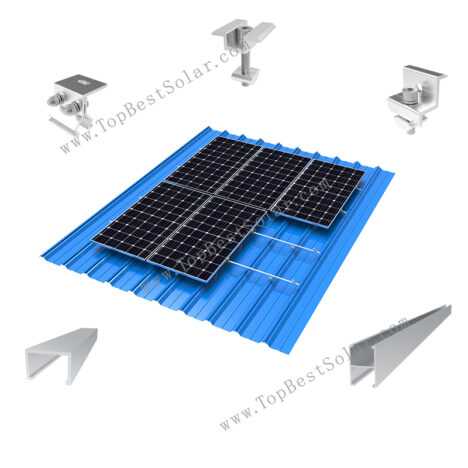
For commercial and industrial building owners, a standing seam metal roof represents a significant long-term asset. The last thing anyone wants is to compromise its integrity with a poorly designed solar installation. The core challenge isn’t just generating power—it’s doing so without drilling thousands of holes that invite leaks, void warranties, and weaken the structure. The solution lies in a specific class of engineering: the non-penetrating, clamp-on solar mounting system. When designed with high-strength aluminum alloys and a deep understanding of wind dynamics, this approach doesn’t just add solar; it enhances the building’s resilience.
The “No-Holes” Advantage: Preserving Your Roof’s Lifespan
The single biggest risk in metal roof solar is penetration. Every drilled hole is a potential failure point for leaks, corrosion, and thermal bridging. A true clamp-on system eliminates this risk entirely.
-
Warranty Protection: By gripping the vertical seams of the roof without piercing the membrane, these systems preserve the manufacturer’s warranty on the roofing material.
-
Zero Waterproofing Complexity: There are no sealants to degrade over time, no gaskets to fail under UV exposure. The installation is mechanically fastened, not chemically bonded.
-
Thermal Performance: Without penetrations, there is no pathway for thermal bridging or condensation to form, maintaining the building’s thermal envelope.
Built for the Extremes: The 60 m/s Wind Rating Explained
A common misconception is that “no-drill” means “less secure.” In reality, a properly engineered clamp-on system can be rated for wind speeds up to 60 m/s (134 mph)—equivalent to a Category 4 hurricane. This isn’t achieved by brute force, but by intelligent design.
-
Aerodynamic Profile: High-quality systems use low-profile rails and clamps that allow wind to flow over and around the array with minimal lift.
-
Material Science: The use of AL6005-T5 aluminum alloy for rails and clamps provides a critical balance of strength and lightweight durability. This specific grade offers superior fatigue resistance compared to standard alloys, ensuring the system can handle decades of wind cycling without loosening.
-
Distributed Load: The clamping force is distributed evenly along the length of the seam, which is structurally the strongest part of a metal roof. This is often more secure than point-loaded lag bolts into wooden trusses.
The Speed of Installation: From Weeks to Days
Time on the roof is a major cost driver and safety risk. A pre-assembled, clamp-on system dramatically reduces both.
-
No Welding, No Drilling: Installers work from the roof’s walkable seams, snapping clamps into place and sliding rails on. This requires no heavy machinery or hot-work permits.
-
Modular Components: With standardized mid-clamps, end-clamps, and rail splices, the installation becomes a repeatable, tool-friendly process. Crews can be trained quickly, and projects scale linearly without unexpected delays from hitting decking obstructions.
-
Predictable ROI: Faster installation means lower labor costs and a quicker return on investment, as the system starts generating revenue sooner.
Beyond Mounting: The Hidden Benefits of a “Solar Canopy”
The space between the panels and the roof surface creates a functional air gap that offers secondary benefits.
-
Passive Cooling: The gap allows for natural ventilation underneath the modules, lowering their operating temperature and increasing energy yield (solar panels lose efficiency as they heat up).
-
Roof Protection: The array acts as a physical shield against hail, UV degradation, and thermal cycling, potentially extending the life of the underlying roofing material.
-
Snow Shedding: The tilt of the array encourages snow to slide off, preventing dangerous accumulation and ice damming at the eaves.
The Verdict: A Smarter Upgrade for Smart Buildings
Choosing a non-penetrating clamp-on system is not just a technical decision; it’s a financial one. It transforms a liability (roof penetrations) into an asset (a resilient, revenue-generating skin). For any building with a standing seam metal roof, this approach delivers the trifecta of preserved asset value, extreme weather resilience, and rapid deployment. It proves that the best solar installations are the ones you barely have to think about after they’re up.